Skeletal System Worksheet - Grade 12
A Grade 12 science worksheet covering the human skeletal system, including bone types, functions, and disorders.
Includes
Standards
Topics
Skeletal System Worksheet
Name:
Date:
Score:
Read each question carefully and provide your best answer. For multiple choice, circle the correct option. For fill-in-the-blanks, write your answer on the line provided. For short answer, use the space below the question.
1. Which of the following is NOT a primary function of the skeletal system?
Support and protection
Mineral storage
Hormone production
Blood cell formation
2. The axial skeleton includes which of the following bones?
Femur
Ribs
Humerus
Tibia
3. The process of bone formation is called .
4. Immovable joints, such as those found in the skull, are called .
5. The primary mineral stored in bones is .
6. Briefly explain the difference between compact bone and spongy bone.
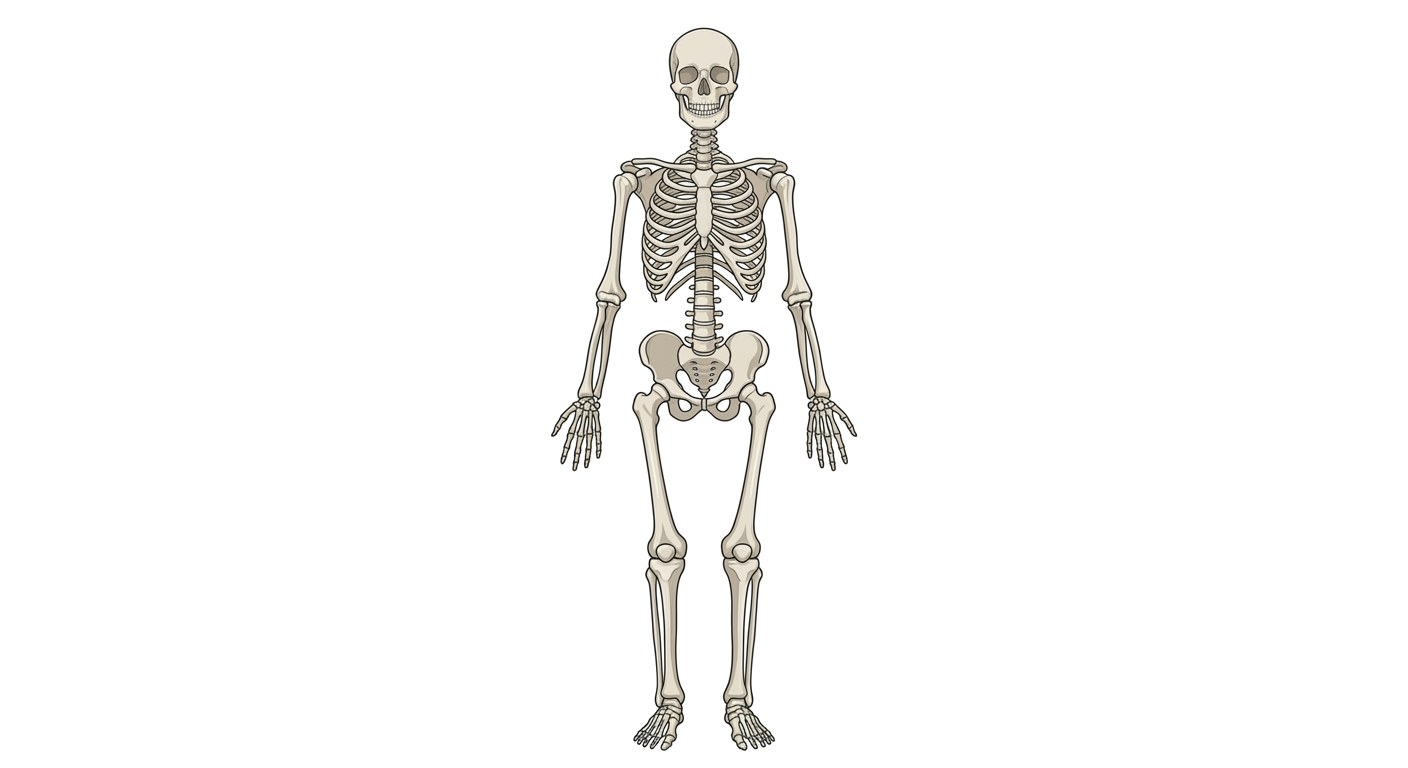
7. Label the following bones on the diagram below:
A. Skull
B. Rib Cage
C. Vertebral Column
D. Femur
E. Humerus
8. Red bone marrow is primarily responsible for fat storage.
True
False
9. Osteoporosis is a condition characterized by increased bone density.
True
False
Match each term with its correct definition.
10. Osteoblast
a. Bone-destroying cell
11. Osteoclast
b. Bone-forming cell
12. Osteocyte
c. Mature bone cell
Related Worksheets
Grade 12 Biology: Dissection Fundamentals
This worksheet covers essential concepts and practices in biological dissection, including safety, tool identification, and ethical considerations for Grade 12 Biology students.
Grade 12 Biology: The Integumentary System
This worksheet covers the structure, function, and common conditions of the human integumentary system for Grade 12 Biology students.
Grade 12 Biology: Heart Rate
This worksheet explores the physiological mechanisms regulating heart rate, factors influencing it, and methods of measurement for Grade 12 Biology students.
Grade 12 Non-Mendelian Inheritance Worksheet
Explore advanced concepts in genetics beyond simple Mendelian patterns, including incomplete dominance, codominance, multiple alleles, and polygenic inheritance.