Skin Structure and Function
Explore the intricate layers and functions of human skin with this Grade 12 biology worksheet.
Includes
Standards
Topics
Skin Structure and Function
Name:
Date:
Score:
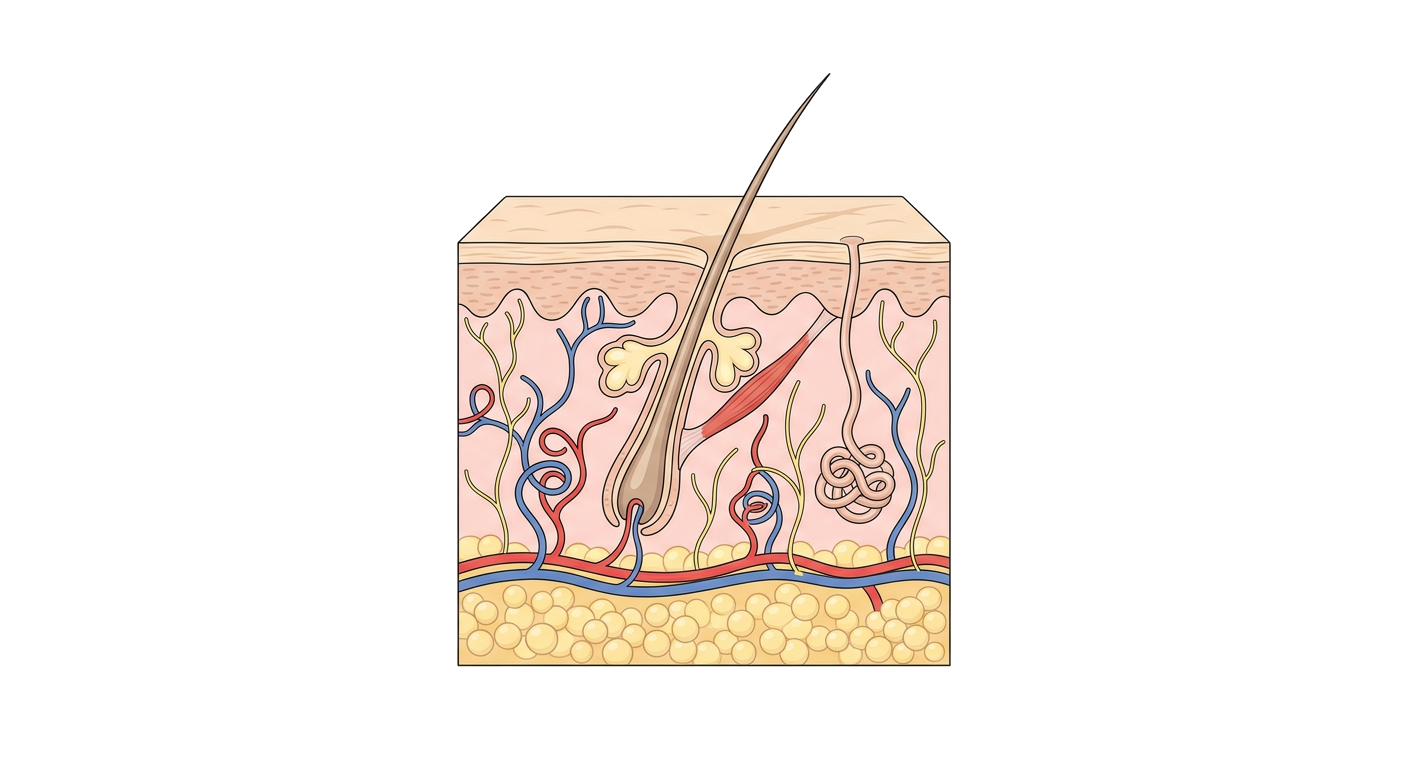
Read each question carefully and answer to the best of your ability. Refer to the diagram provided for relevant questions.
Observe the diagram of the human skin cross-section below:
1. Which layer of the skin is primarily responsible for protection against UV radiation due to the presence of melanin?
Dermis
Epidermis
Hypodermis
Subcutaneous layer
2. Which of the following is a primary function of the sebaceous glands?
Producing sweat for cooling
Secreting sebum to lubricate skin and hair
Storing fat for insulation
Detecting touch and pressure
3. The outermost layer of the epidermis is the stratum .
4. cells are responsible for producing the pigment melanin.
5. The dermis is primarily composed of tissue.
6. Describe two distinct functions of the hypodermis.
7. Explain how the skin helps regulate body temperature.
8. Langerhans cells in the epidermis play a crucial role in the immune response.
True
False
9. Hair follicles are located in the epidermis.
True
False
Match the skin component with its primary function.
10. Keratinocytes
a. Provides insulation and energy storage
11. Adipose tissue
b. Produce a tough, fibrous protein
12. Meissner's corpuscles
c. Detect light touch
Related Worksheets
Grade 12 Biology: Dissection Fundamentals
This worksheet covers essential concepts and practices in biological dissection, including safety, tool identification, and ethical considerations for Grade 12 Biology students.
Grade 12 Biology: The Integumentary System
This worksheet covers the structure, function, and common conditions of the human integumentary system for Grade 12 Biology students.
Grade 12 Biology: Heart Rate
This worksheet explores the physiological mechanisms regulating heart rate, factors influencing it, and methods of measurement for Grade 12 Biology students.
Grade 12 Non-Mendelian Inheritance Worksheet
Explore advanced concepts in genetics beyond simple Mendelian patterns, including incomplete dominance, codominance, multiple alleles, and polygenic inheritance.