Grade 12 Turkey Anatomy Worksheet
Anatomy worksheet for Grade 12 students focusing on the internal and external structures of a turkey, including organ systems and physiological functions.
Includes
Standards
Topics
Grade 12 Turkey Anatomy Worksheet
Name:
Date:
Score:
Read each question carefully and provide detailed answers based on your knowledge of turkey anatomy and physiology. Refer to the provided diagram where applicable.
Analyze the provided diagram of bird internal anatomy (which is highly similar to turkey anatomy) to answer the following questions.
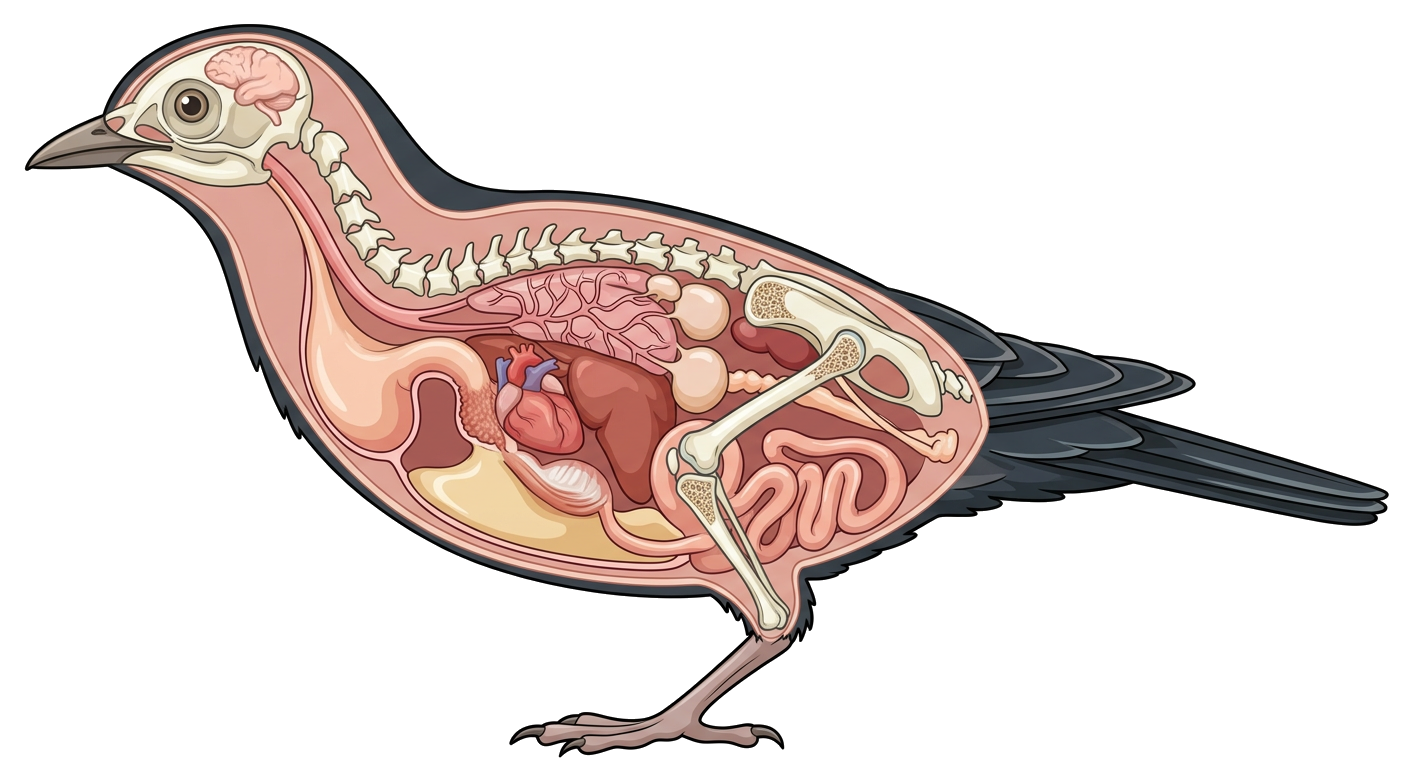
1. Identify and describe the primary function of the organ labeled 'Crop' in a turkey's digestive system.
2. Explain the role of the 'Gizzard' in the turkey's digestion process and how it differs from a mammalian stomach.
3. Which of the following respiratory structures is unique to birds, including turkeys, and allows for unidirectional airflow?
Alveoli
Diaphragm
Air sacs
Bronchioles
4. The uropygial gland, prominent in turkeys, is primarily responsible for:
Producing digestive enzymes
Feather waterproofing and conditioning
Regulating body temperature
Producing vocalizations
5. The turkey's strong breast muscles are primarily responsible for powering , a crucial adaptation for escape from predators.
6. Unlike mammals, turkeys possess a single opening for digestive, urinary, and reproductive tracts, known as the .
7. Turkeys have a four-chambered heart, similar to mammals, which efficiently separates oxygenated and deoxygenated blood.
True
False
8. The 'snood' and 'wattle' are external anatomical features of a turkey that play a role in thermoregulation and display during courtship.
True
False
9. Describe the primary adaptations of a turkey's skeletal system that enable flight, despite their relatively large body size.
10. Discuss the function of the turkey's specialized vision, including the role of photoreceptors, in its natural habitat.
Related Worksheets
Grade 12 Biology: Dissection Fundamentals
This worksheet covers essential concepts and practices in biological dissection, including safety, tool identification, and ethical considerations for Grade 12 Biology students.
Grade 12 Biology: The Integumentary System
This worksheet covers the structure, function, and common conditions of the human integumentary system for Grade 12 Biology students.
Grade 12 Biology: Heart Rate
This worksheet explores the physiological mechanisms regulating heart rate, factors influencing it, and methods of measurement for Grade 12 Biology students.
Grade 12 Non-Mendelian Inheritance Worksheet
Explore advanced concepts in genetics beyond simple Mendelian patterns, including incomplete dominance, codominance, multiple alleles, and polygenic inheritance.