Relative Dating Worksheet
Explore the principles of relative dating and how geologists determine the sequence of geological events.
Includes
Standards
Topics
Relative Dating Worksheet
Name:
Date:
Score:
Read each question carefully and answer to the best of your ability. Refer to your knowledge of relative dating principles.
1. Which principle of relative dating states that in an undisturbed sequence of sedimentary strata, the oldest layers are at the bottom and the youngest are at the top?
Principle of Cross-Cutting Relationships
Principle of Superposition
Principle of Original Horizontality
Principle of Faunal Succession
2. An unconformity represents:
A continuous deposition of sediments
A gap in the geological record due to erosion or non-deposition
The folding of rock layers
The presence of index fossils
3. The Principle of states that geological features which cut across others are younger than the features they cut.
4. Fossils used to define and identify geologic periods are known as fossils.
5. Explain the Principle of Original Horizontality and its significance in relative dating.
6. Describe how index fossils are used to correlate rock layers across different locations.
7. A disconformity is a type of unconformity where the strata above and below are parallel.
True
False
8. The Principle of Inclusions states that inclusions found in a rock are older than the rock itself.
True
False
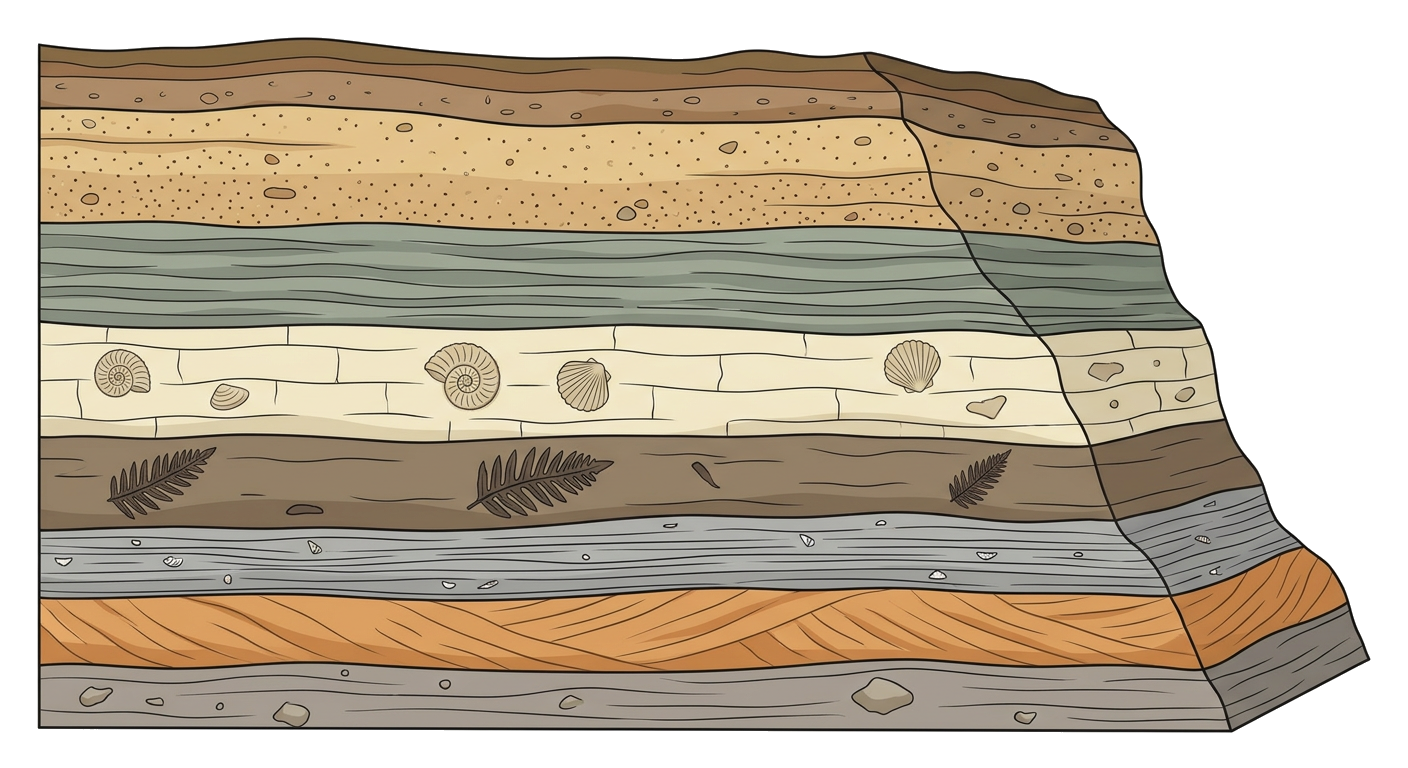
9. Observe the geological cross-section below. Identify the oldest and youngest rock layers and explain your reasoning based on relative dating principles.
Related Worksheets
Sedimentary Rocks: Formation and Characteristics
Explore the formation processes, classification, and key characteristics of sedimentary rocks at a Grade 12 level.
Earthquakes and Volcanoes Worksheet
Explore the geological forces behind earthquakes and volcanoes, plate tectonics, and their impact on Earth's surface.
Grade 12 Environmental Studies Worksheet
This worksheet covers key concepts in Environmental Studies for Grade 12, including ecological principles, climate change, and sustainable practices.
Earth History: Geological Time and Major Events
Explore the vast history of Earth, from its formation to the present day, covering major geological eras, significant biological events, and dating methods.
Convection in the Earth's Mantle
Explore the process of convection within the Earth's mantle and its role in plate tectonics.
Human Population Growth: Dynamics and Impact
Explore the principles of human population growth, including historical trends, factors influencing growth rates, and environmental and societal impacts.
Grade 12 Lab Practical Worksheet
This worksheet assesses understanding of laboratory safety, equipment, experimental design, and data analysis for Grade 12 science students.
Geological Time Scale Exploration
Explore the vastness of geological time, major eras, and significant events in Earth's history.