Autosomal Recessive Inheritance Worksheet
Explore the principles of autosomal recessive inheritance, including Punnett squares, pedigree analysis, and common genetic disorders, suitable for Grade 12 Biology students.
Includes
Standards
Autosomal Recessive Inheritance
Name:
Date:
Score:
Read each question carefully and provide detailed answers. Use the Punnett square provided for relevant questions.
1. In autosomal recessive inheritance, an individual must inherit copies of the mutated gene to express the disorder.
2. Individuals who carry one copy of the mutated gene but do not show symptoms are called .
3. The probability of two carrier parents having an affected child is .
1. Which of the following is a characteristic of autosomal recessive inheritance?
Affected individuals usually have at least one affected parent.
The trait appears in every generation.
Affected individuals can have unaffected parents who are carriers.
Males are more frequently affected than females.
2. If two parents are heterozygous carriers (Aa) for an autosomal recessive disorder, what is the probability that their child will be a carrier?
0%
25%
50%
75%
Consider a hypothetical autosomal recessive disorder where 'A' represents the dominant allele (normal) and 'a' represents the recessive allele (affected). A couple, both carriers (Aa), are planning to have children.
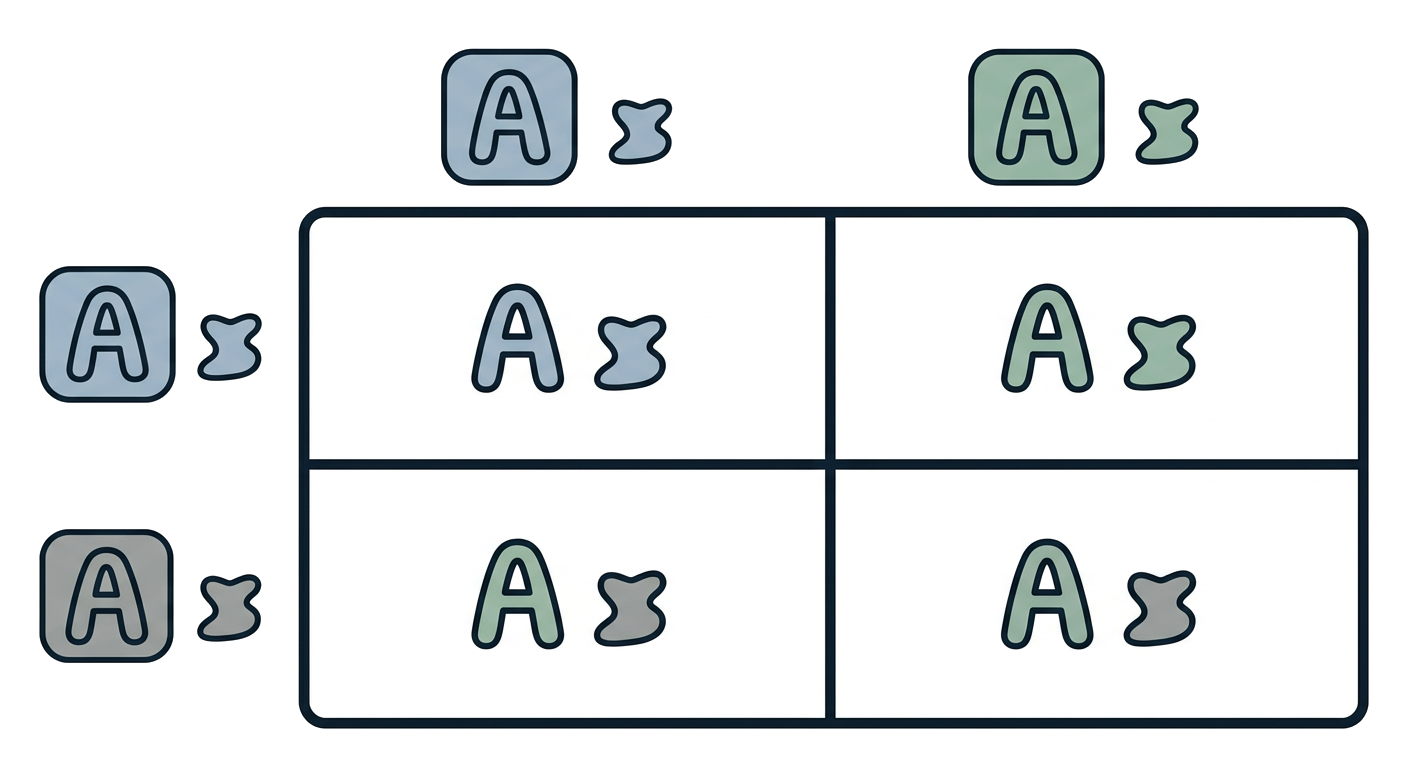
1. Complete the Punnett square above for this cross.
2. What is the genotypic ratio of their offspring?
3. What is the phenotypic ratio of their offspring?
1. If a child has an autosomal recessive disorder, at least one of their parents must also have the disorder.
True
False
2. Autosomal recessive disorders typically skip generations in a pedigree.
True
False
Cystic Fibrosis (CF) is an autosomal recessive disorder. A couple has a child with CF. Neither parent has CF. Explain how this is possible, using appropriate genetic terminology.
Related Worksheets
Grade 12 Biology: Dissection Fundamentals
This worksheet covers essential concepts and practices in biological dissection, including safety, tool identification, and ethical considerations for Grade 12 Biology students.
Grade 12 Biology: The Integumentary System
This worksheet covers the structure, function, and common conditions of the human integumentary system for Grade 12 Biology students.
Grade 12 Biology: Heart Rate
This worksheet explores the physiological mechanisms regulating heart rate, factors influencing it, and methods of measurement for Grade 12 Biology students.
Grade 12 Non-Mendelian Inheritance Worksheet
Explore advanced concepts in genetics beyond simple Mendelian patterns, including incomplete dominance, codominance, multiple alleles, and polygenic inheritance.