Doppler Effect Advanced Concepts
A Grade 12 physics worksheet exploring the Doppler Effect, its applications, and calculations for sound and light waves.
Includes
Standards
Topics
Doppler Effect Advanced Concepts
Name:
Date:
Score:
Read each question carefully and provide detailed answers.
1. Describe the Doppler Effect in your own words, explaining how it applies to both sound and light waves. Provide a real-world example for each.
2. Examine the diagram below. Explain how the observer perceives the sound frequency as the source moves towards and away from them.
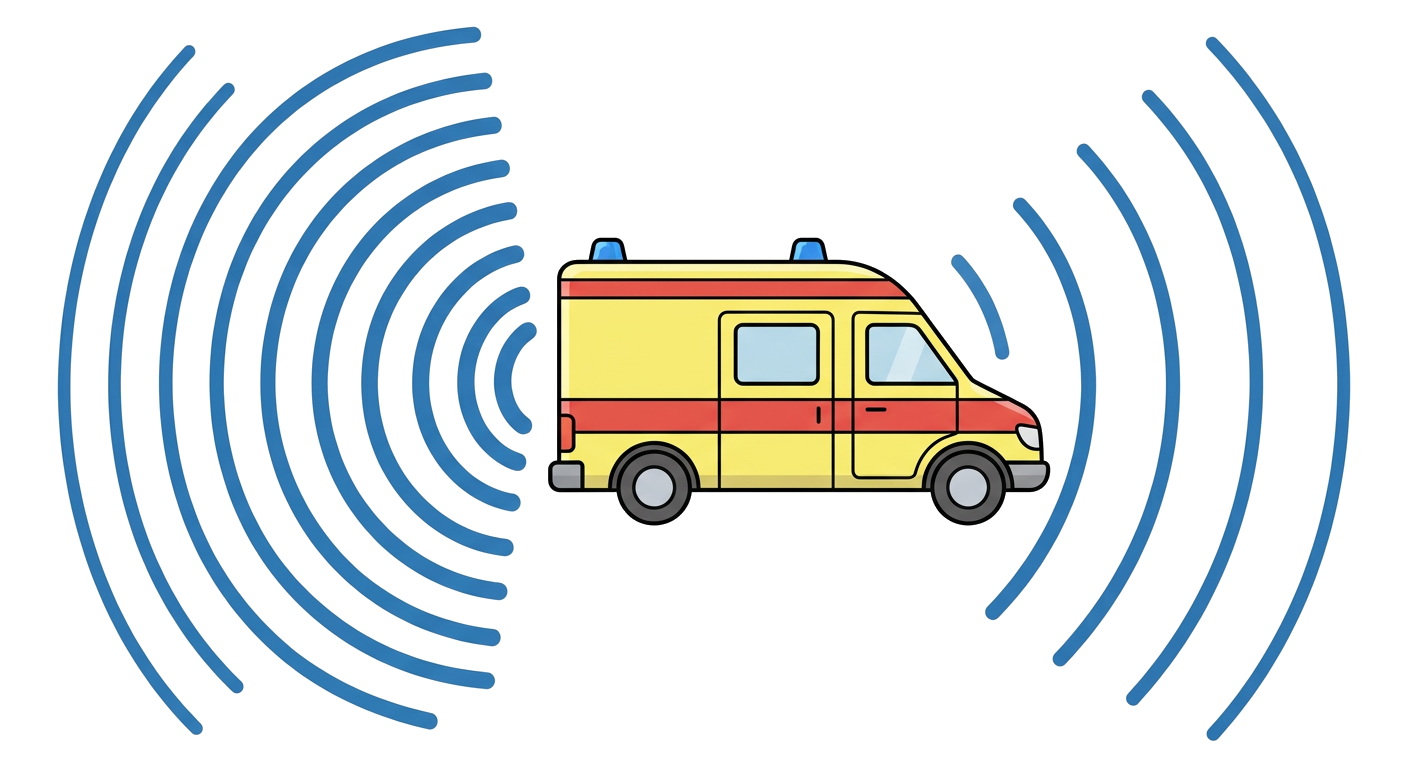
3. When a source of sound moves towards an observer, the perceived frequency , and the wavelength .
4. The formula for the observed frequency of sound when the source is moving and the observer is stationary is f' = f * (v ± v_o) / (v ∓ v_s). In this formula, v represents the of sound, v_o represents the of the observer, and v_s represents the of the source.
5. For electromagnetic waves, a shift to a higher frequency is called a , and a shift to a lower frequency is called a .
6. Which of the following phenomena is NOT a direct application or consequence of the Doppler Effect?
Medical ultrasound imaging
Radar speed guns
The rainbow effect from a prism
Astronomical redshift/blueshift
7. An ambulance siren emits a frequency of 1000 Hz. If the ambulance is moving towards a stationary observer at 30 m/s, and the speed of sound is 343 m/s, what is the observed frequency?
912 Hz
1000 Hz
1096 Hz
1100 Hz
8. A police car with a 1200 Hz siren is chasing a car. The police car is moving at 40 m/s and the car being chased is moving at 25 m/s. Calculate the frequency heard by the driver of the car being chased. (Speed of sound = 343 m/s)
9. A distant galaxy is observed to have a spectral line that normally has a wavelength of 656.3 nm, but it is observed at 665.0 nm. Is the galaxy moving towards or away from Earth? Calculate its recession or approach velocity. (Speed of light = 3.00 x 10^8 m/s)
10. The Doppler Effect for light depends on the relative speed between the source and the observer, but not on the direction of motion relative to a medium.
True
False
Related Worksheets
Grade 12 Conduction Worksheet
This worksheet covers key concepts of conduction, including mechanisms, factors affecting heat transfer, and applications, suitable for Grade 12 Physics students.
Coulomb's Law and Electric Force Worksheet
Explore Coulomb's Law and calculate electric forces between charged particles with this Grade 12 Physics worksheet.
Grade 12 Magnetism Worksheet
A comprehensive worksheet for Grade 12 Physics students covering fundamental concepts of magnetism, including magnetic fields, forces, and applications.
Grade 12 Light Energy Worksheet
A comprehensive worksheet for Grade 12 physics students covering key concepts of light energy, including its wave-particle duality, electromagnetic spectrum, and optical phenomena.
Grade 12 Physics: Electric Charge
A Grade 12 Physics worksheet covering fundamental concepts of electric charge, Coulomb's Law, and electric fields.
Magnetic Fields Worksheet
This worksheet covers fundamental concepts of magnetic fields, including their generation, properties, and interactions, suitable for Grade 12 Physics students.
Grade 12 Physics: Magnetic Forces, Fields, and Faraday's Law
Explore magnetic forces on charges and currents, understand magnetic fields, and delve into Faraday's Law of electromagnetic induction.
Logic Gates Fundamentals
A Grade 12 science worksheet covering the basics of logic gates, their symbols, truth tables, and Boolean expressions.