Electric Power and DC Circuits Worksheet
Grade 12 Physics worksheet covering fundamental concepts of electric power, DC circuits, Ohm's Law, and Kirchhoff's Laws.
Includes
Standards
Topics
Electric Power and DC Circuits
Name:
Date:
Score:
Read each question carefully and answer to the best of your ability. Show all your work for calculations.
1. Which of the following is the correct definition of electric power?
The rate at which charge flows through a circuit.
The amount of energy consumed per unit time.
The opposition to the flow of electric current.
The potential difference between two points in a circuit.
2. In a series circuit, what happens to the total resistance as more resistors are added?
It decreases.
It increases.
It remains the same.
It depends on the value of the resistors.
3. Ohm's Law states that voltage is directly proportional to and .
4. Kirchhoff's Current Law (KCL) states that the total current entering a junction must equal the total current that junction.
5. Explain the difference between a series circuit and a parallel circuit. You may refer to the images below.
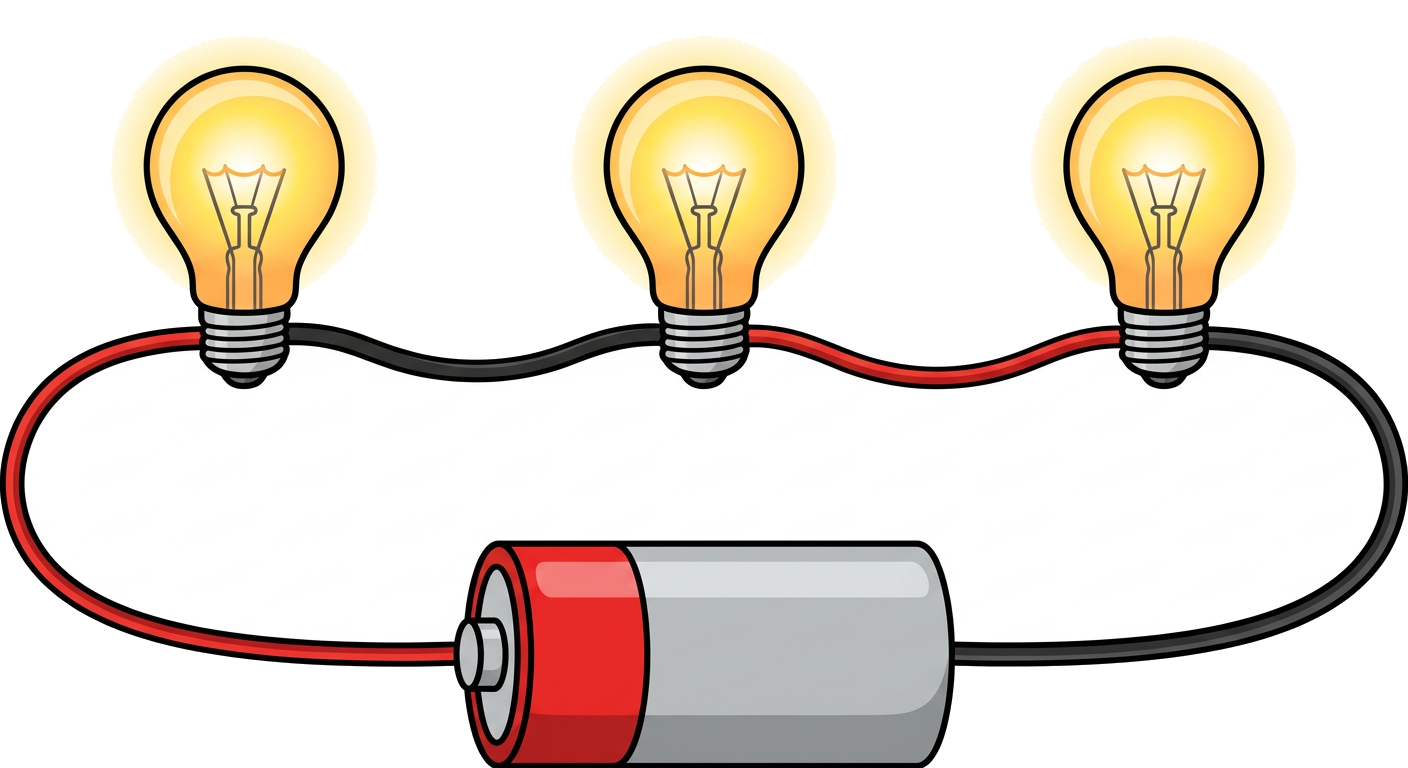
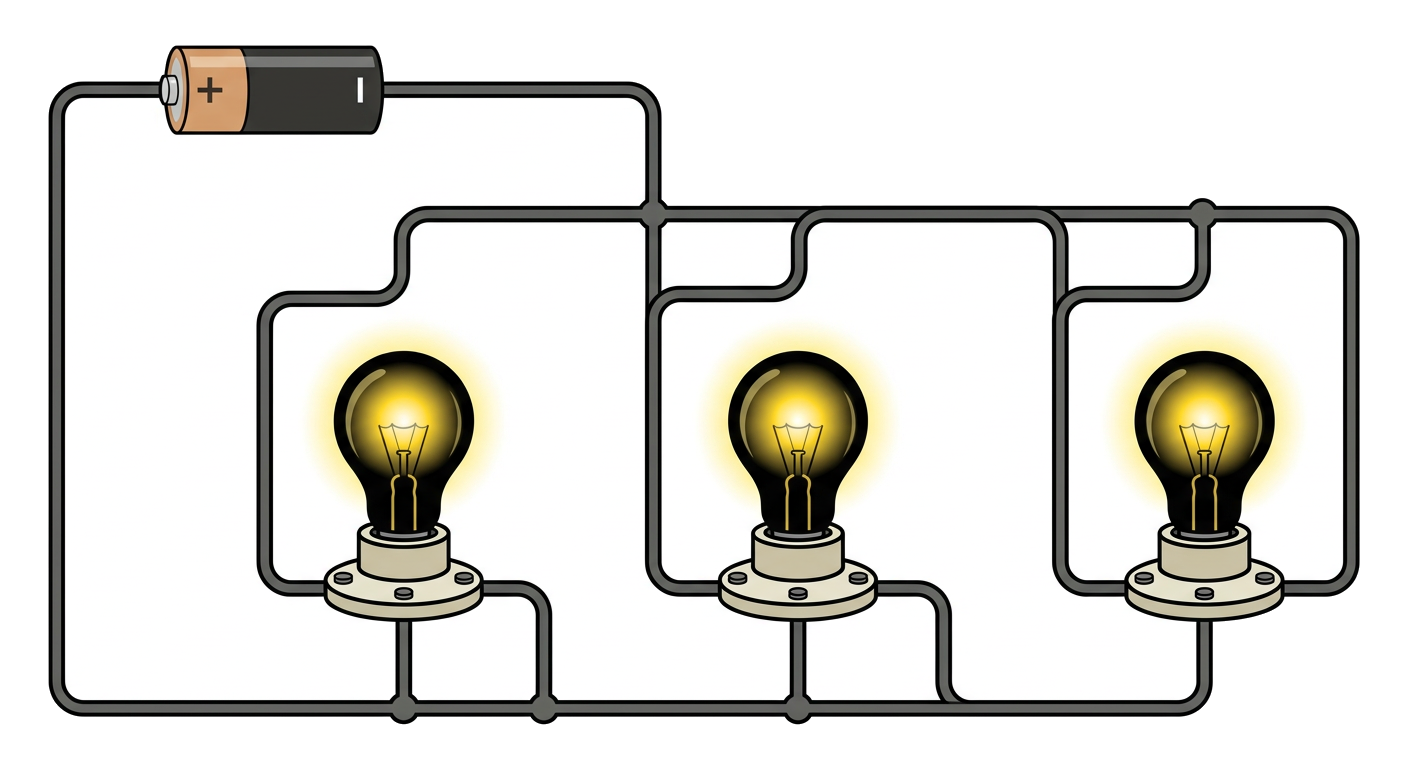
6. The total power consumed in a parallel circuit is the sum of the power consumed by each individual component.
True
False
7. In a DC circuit, the current flows in only one direction.
True
False
8. A 12V battery is connected to three resistors in series: R1 = 2Ω, R2 = 4Ω, and R3 = 6Ω. Calculate the total resistance of the circuit, the total current flowing through the circuit, and the voltage drop across each resistor.
9. Two resistors, R1 = 10Ω and R2 = 15Ω, are connected in parallel across a 30V power supply. Calculate the equivalent resistance of the parallel combination, the total current drawn from the supply, and the current flowing through each resistor.
Related Worksheets
Grade 12 Conduction Worksheet
This worksheet covers key concepts of conduction, including mechanisms, factors affecting heat transfer, and applications, suitable for Grade 12 Physics students.
Coulomb's Law and Electric Force Worksheet
Explore Coulomb's Law and calculate electric forces between charged particles with this Grade 12 Physics worksheet.
Grade 12 Magnetism Worksheet
A comprehensive worksheet for Grade 12 Physics students covering fundamental concepts of magnetism, including magnetic fields, forces, and applications.
Grade 12 Light Energy Worksheet
A comprehensive worksheet for Grade 12 physics students covering key concepts of light energy, including its wave-particle duality, electromagnetic spectrum, and optical phenomena.
Grade 12 Physics: Electric Charge
A Grade 12 Physics worksheet covering fundamental concepts of electric charge, Coulomb's Law, and electric fields.
Magnetic Fields Worksheet
This worksheet covers fundamental concepts of magnetic fields, including their generation, properties, and interactions, suitable for Grade 12 Physics students.
Grade 12 Physics: Magnetic Forces, Fields, and Faraday's Law
Explore magnetic forces on charges and currents, understand magnetic fields, and delve into Faraday's Law of electromagnetic induction.
Logic Gates Fundamentals
A Grade 12 science worksheet covering the basics of logic gates, their symbols, truth tables, and Boolean expressions.