Grade 12 Biology: Nerve Impulse Worksheet
This worksheet covers the fundamental concepts of nerve impulse transmission, including action potentials, resting potentials, and synaptic transmission, suitable for Grade 12 Biology students.
Includes
Standards
Topics
Grade 12 Biology: Nerve Impulse
Name:
Date:
Score:
Read each question carefully and answer to the best of your ability. Refer to the provided diagrams where applicable.
1. Which of the following best describes the resting membrane potential of a neuron?
The inside of the neuron is positively charged relative to the outside.
There is an equal distribution of ions across the membrane.
The inside of the neuron is negatively charged relative to the outside.
The membrane is impermeable to all ions.
2. What is the primary role of the sodium-potassium pump in maintaining the resting potential?
To actively transport sodium ions into the cell.
To actively transport potassium ions out of the cell.
To establish and maintain the concentration gradients of Na+ and K+.
To facilitate the diffusion of ions across the membrane.
1. The rapid influx of ions into the neuron causes depolarization during an action potential.
2. Repolarization of the neuron membrane is primarily due to the efflux of ions.
3. The period ensures that an action potential moves in one direction along the axon.
1. Briefly describe the 'all-or-none' principle of an action potential.
2. Explain the role of myelin in nerve impulse conduction.
1. Neurotransmitters are released from the postsynaptic neuron.
True
False
2. Saltatory conduction occurs in unmyelinated axons.
True
False
Identify the labeled parts of the neuron in the diagram below:
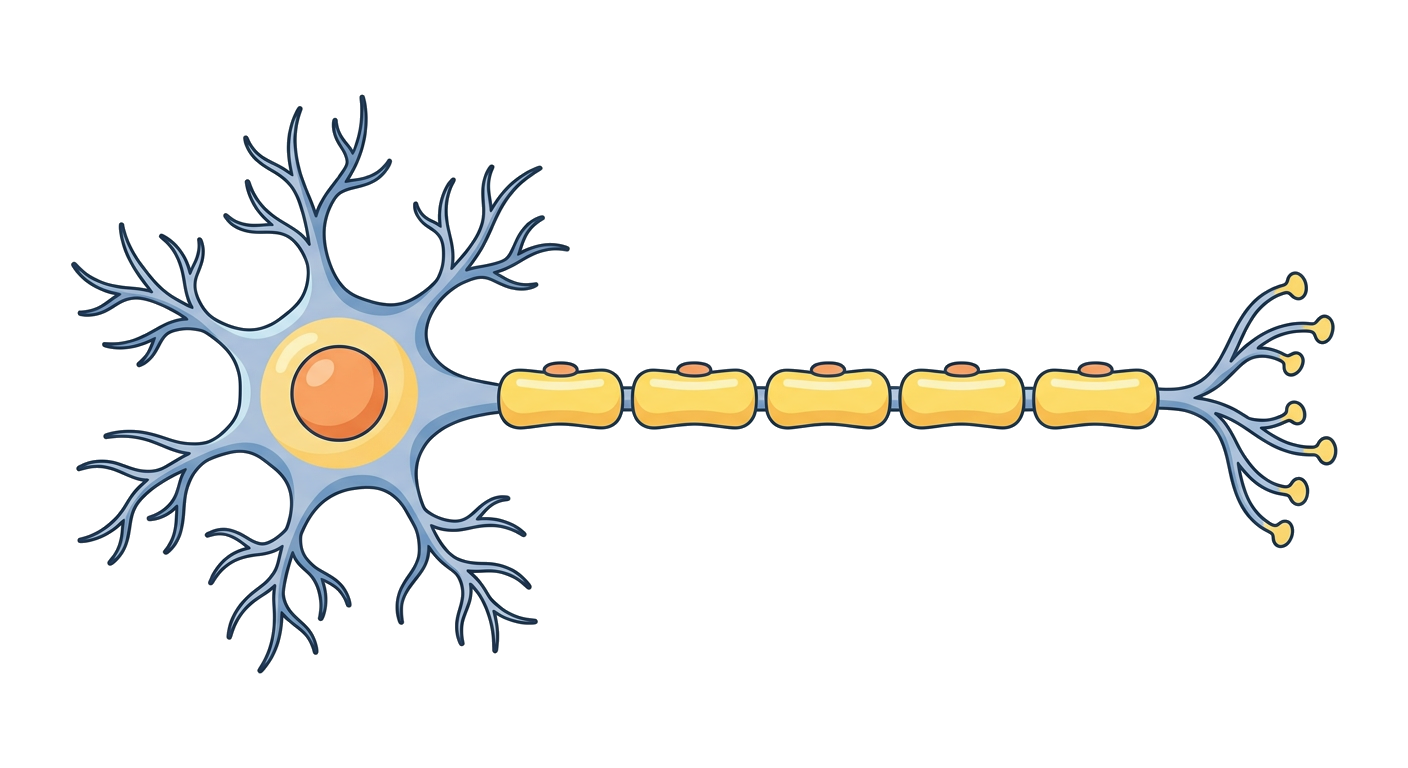
A:
B:
C:
D:
E:
Match each term with its correct definition.
1. Synapse
a. The minimum stimulus required to trigger an action potential.
2. Threshold
b. The junction between two neurons where signals are transmitted.
3. Neurotransmitter
c. Chemical messengers that transmit signals across a synapse.
Related Worksheets
Grade 12 Biology: Dissection Fundamentals
This worksheet covers essential concepts and practices in biological dissection, including safety, tool identification, and ethical considerations for Grade 12 Biology students.
Grade 12 Biology: The Integumentary System
This worksheet covers the structure, function, and common conditions of the human integumentary system for Grade 12 Biology students.
Grade 12 Biology: Heart Rate
This worksheet explores the physiological mechanisms regulating heart rate, factors influencing it, and methods of measurement for Grade 12 Biology students.
Grade 12 Non-Mendelian Inheritance Worksheet
Explore advanced concepts in genetics beyond simple Mendelian patterns, including incomplete dominance, codominance, multiple alleles, and polygenic inheritance.