State Government Fundamentals
This worksheet covers fundamental concepts of state government in the United States, including structure, functions, and key principles.
Includes
Standards
Topics
State Government Fundamentals
Name:
Date:
Score:
Read each question carefully and provide your best answer. For multiple choice questions, circle the letter corresponding to your chosen answer. For fill-in-the-blank questions, complete the sentence with the most appropriate term. For short answer questions, write a concise and informative response.
1. Which of the following is NOT a power typically reserved for state governments in the United States?
Establishing local governments
Regulating interstate commerce
Conducting elections
Issuing licenses (e.g., driver's, marriage)
2. The primary legislative body at the state level is typically called the:
Congress
Parliament
State Legislature / General Assembly
Supreme Court
3. The principle of divides governmental powers between the federal and state governments.
4. The chief executive of a state government is known as the .
5. Most state constitutions are structured similarly to the U.S. Constitution, typically including a bill of rights and provisions for three branches of government: the executive, legislative, and branches.
6. State governments have the authority to declare war.
True
False
7. Education policy is primarily a responsibility of state and local governments.
True
False
8. Briefly explain the concept of 'reserved powers' as it relates to state governments.
9. Identify two key functions of the judicial branch at the state level.
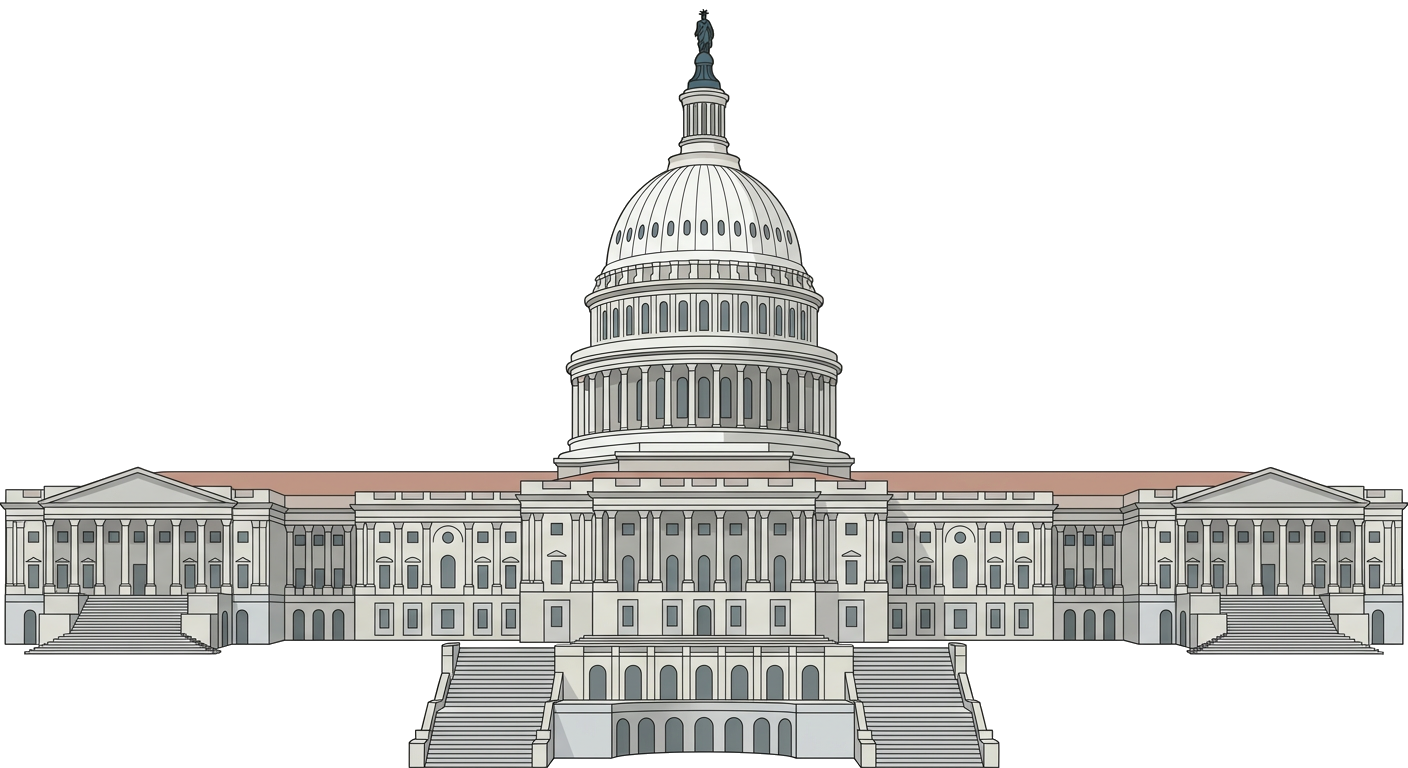
10. The image below depicts the U.S. Capitol Building, a symbol of federal government. In what ways does a state capitol building typically differ from or resemble the U.S. Capitol in terms of its function and symbolic importance?
Related Worksheets
Congressional Committees Worksheet
Explore the structure, functions, and types of congressional committees in the U.S. government.
Understanding Political Parties
A Grade 12 Social Studies worksheet exploring the role, functions, and types of political parties in a democratic system.
The Legislative Process: How a Bill Becomes a Law
This worksheet covers the steps and key aspects of the legislative process in the United States, from bill introduction to enactment, suitable for Grade 12 Social Studies.